
C212 câu, khoảng 7 phút
Nghe từng câu, gõ lại đúng từng chữ. Chữ đúng hiện xanh ngay khi bạn gõ.
Autosterograms start with a base pattern that repeats across the image but with select dots or pixels shifted to vary the depth and compose the 3D figure.
The first random-dot autostereograms were made by hand in the 1970s.
This one by a Japanese graphic designer shows an array of hidden squares and this one by a Swiss painter has overlapping rectangles.
But by the 1980s, vision researcher Christopher Tyler and programmer Maureen Clark had come up with an algorithm that could embed more complicated depth images into a random-dot
Using the red dots as a guide, you should see a 3D surface pop out that’s much more complicated than a wallpaper or a simple rectangle.
The algorithms that produce these images work from a depth map — that's a black and white image that tells the program to make the repetition interval shorter for the dots that make
up the lighter, and nearer, parts of the image.
In the final product you can’t tell which dots have been shifted or how much, but if you go back to that Photoshop trick and scan through the image — you can see how
the nearest parts of the shark repeat at closer intervals than the most distant parts of the shark.
Everything in the base image repeats at the same interval, except the dots that make up the shark.
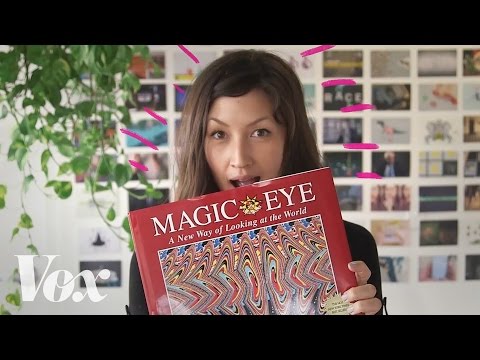
In the 90s, artist Cheri Smith and engineer Tom Baccei developed their own method, using bright colorful patterns as their base.
They branded them as “Magic Eye” and published the first of many books in 1993.