
C212 câu, khoảng 7 phút
Nghe từng câu, gõ lại đúng từng chữ. Chữ đúng hiện xanh ngay khi bạn gõ.
And that same principle of creating a 3D image by showing each eye a slightly different picture continues with 3D glasses and virtual reality headsets.
But it’s not all for amusement.
Stereoscopy has also been used for all sorts of aerial imaging applications.
British photo interpreters in World War 2 used overlapping images taken from airplanes to detect Nazi military assets.
This ability of stereoscopes to thwart camouflage by making objects pop out of seemingly flat aerial images inspired the development of the random dot stereogram — that’s the kind
with a hidden 3D image.
In 1960, a leading vision researcher named Bela Julesz created a computer-generated random-dot stereogram.
He started with a grid of random dots and duplicated it, but in the copy, he shifted a square patch of the dots slightly to the left, filling in the leftover space with other random dots.
If you look at these images through a stereoscope, or if you’ve trained your eyes enough to free-fuse the images by pointing one eye at each one, you’ll see the square pop out
from the random dots.
With this experiment, Julesz showed that the brain could detect depth even without any recognizable objects in the images.
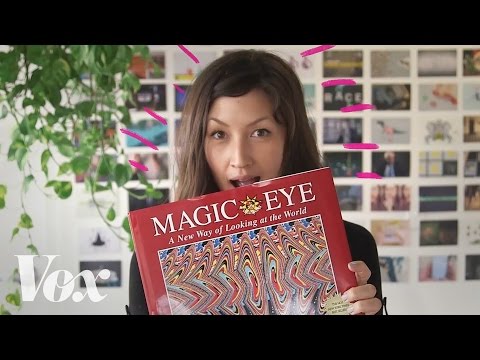
What’s different about the Magic Eye-type of pictures, also known as “autostereograms” is that you don’t need any special device to view them because it’s one image instead of two.